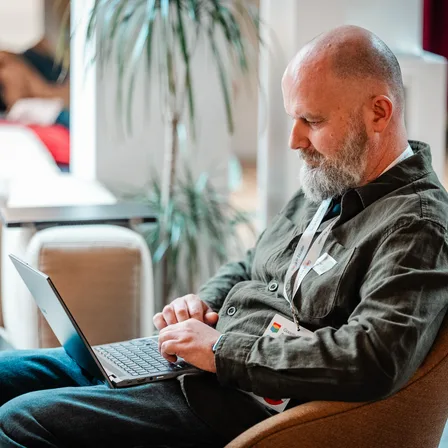
Igor
Wypijewski
A school is a system.
Not a collection of random decisions.
For many years, I worked at a university — in an environment where thinking, analysis, and exploration were at the core of working with people.
When I moved into a school setting, I encountered something very different:
a mix of disconnected tools, accidental technology decisions, and systems that often burden teachers instead of supporting them.
That was the turning point.
Instead of adapting to the chaos, I started breaking it down — and redesigning it from the ground up.
What I do
I design and implement educational environments built on three pillars:
system architecture, data, and decision-making.
I don’t introduce “more tools.”
I remove what’s unnecessary and build systems that actually work.
Architecture over randomness
Most schools evolve by adding more platforms, more accounts, more tools.
The result is predictable:
loss of control, security risks, and growing frustration.
My approach is different.
I design schools around a single, coherent environment — typically based on Google Workspace — where:
- / access is role-based, not improvised
- / data has structure and ownership
- / the system is manageable, not inherited
AI without illusions
AI in education is currently surrounded by noise.
Too often, it’s reduced to content generation and superficial “efficiency gains” that don’t solve real problems.
My work with AI focuses on:
- > predictive models
- > educational data analysis
- > decision support at the leadership level
Always with a strong emphasis on compliance (including the AI Act) and real-world applicability.
AI is not the goal. It is a tool within a well-designed system.
Education as a cognitive process
Technology is only a means.
The real question is:
does a school teach thinking, or just content delivery?
In my own teaching practice:
I combine computer science and physics through interdisciplinary projects.
I move away from content-driven instruction.
I create space for exploration and understanding.
Verification Protocol
Education doesn’t need more tools.
It needs less chaos.