Granulation: Why AI Sabotage Returns Critical Thinking to the Classroom
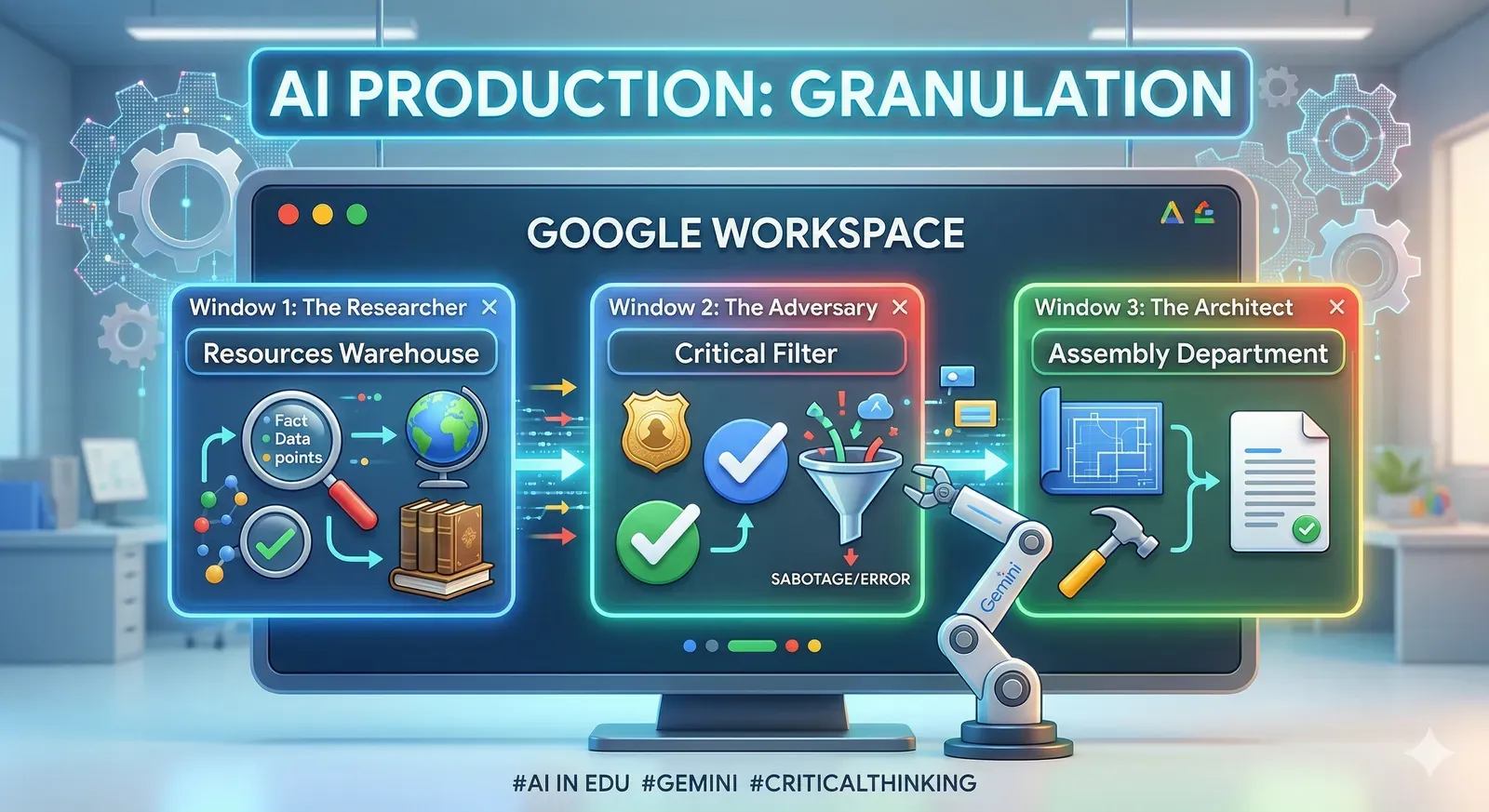
We often talk about AI in education as a “shortcut.” But in my classroom, we’ve discovered a more powerful—and more cognitively demanding—framework. We call it Granulation.
The “Fast Food” Knowledge Trap
Most users approach AI with a “Fast Food” mindset: One prompt, one window, one instant result. It’s convenient, but it’s passive. It creates an illusion of competence where the user accepts the first output without critique. In schools, this reinforces the habit of seeing knowledge as a static product to be consumed, rather than a process to be engineered.
When my students started working with multiple AI windows (Gemini Sidepanel + Docs) simultaneously, they found it “exhausting.” Good. That exhaustion is the sound of critical thinking returning to the classroom.
What is Granulation?
Granulation is the intentional breaking down of a complex task into smaller, specialized “granules” processed across different AI instances. Instead of asking one window to “write an essay,” we deploy an ecosystem:
- The Researcher (Window A): Extracts raw, verified facts.
- The Adversary (Window B): Challenges logic and hunts for “hallucinations.”
- The Architect (Window C): Structures the verified data into a final narrative.
The “Sabotage” Method: Training AI Audits
To break the “Fast Food” habit, I use Sabotage. I intentionally plant errors — anachronisms, logical fallacies, or fake citations — in the initial materials. The student’s job isn’t just to “get the answer,” but to use their granulated AI setup to detect the sabotage.
Case Study: History (The Zimmermann Telegram)
- The Sabotage: A text claiming the 1917 telegram was sent via fiber-optics to Italy to join the Central Powers.
- The Granulation: Window A finds the true facts. Window B identifies the technical and geopolitical impossibilities. Window C rewrites history accurately.
- The Result: Students move from “Summarizing” to “Debugging History.”
The Saboteur’s Dekalog for AI Granulation
If you want to master this workflow, follow these rules:
- Never Trust a Single Window. One window is a rumor. Three are data.
- Divide and Conquer. One window = one specific mission.
- The “Poisoned Stream” Axiom. Assume the AI will lie at least once.
- Copy-Paste is Your Filter. Moving data between windows is a distillation process.
- Force a Perspective Shift. If Window A says “Yes,” command Window B to prove Window A is wrong.
- Be the Conductor, Not the Passenger. You decide when the process moves forward.
Master Cards: Classroom Ready Scenarios
📝 History Sabotage (WWI)
Poisoned Input: “In 1917, Germany sent the Zimmermann Telegram via fiber-optic cables to Italy…”
Workflow:
- Window A: Provide 5 core facts of the telegram.
- Window B: Identify 3 technical anachronisms in the input text.
- Window C: Rewrite the paragraph for historical accuracy.
🧪 Biology Sabotage (Photosynthesis)
Poisoned Input: “Plants capture sunlight using Melanin in the mitochondria to convert Nitrogen into glucose at night…”
Workflow:
- Window A: Provide a step-by-step flowchart of Photosynthesis.
- Window B: Identify the biological impossibilities in the text above.
- Window C: Refine the text into a clean lab report.
Why This Matters
This isn’t just a classroom trick. It is a precursor to Agentic Workflows. In the professional world, we are moving toward systems of autonomous AI agents working in sync. Students who master “Granulation” today are developing the systems-thinking skills required to manage the AI-driven workforce of tomorrow.
It’s exhausting because it’s real thinking. It’s hard because it’s true literacy.